Kalahari and Makgadikgadi
In central Botswana, 52,000 km² of semi-arid Kalahari and salt pans as vast as Portugal, explored by 4x4, quad bike or on foot with San communities.
The Kalahari and Makgadikgadi form the southern and central half of Botswana, a mineral landscape that contrasts sharply with the waters of the Okavango Delta. Our team accompanies travelers here who seek something beyond the classic safari: horizons unmarked by relief, a rare silence, and light that shifts hour by hour across the salt crust or red sands.
The Central Kalahari, or Central Kalahari Game Reserve, covers 52,800 km². It is Africa's second-largest reserve. Contrary to what its name suggests, this is not a dune desert but a semi-arid savanna scattered with acacias, fossil pans, and dry valleys such as Deception Valley and Passarge Valley. Wildlife here is more dispersed than at Moremi or Chobe, but you encounter the black-maned lions of the Kalahari, oryx, eland, and vast herds of springbok. Cheetahs and leopards hunt across open landscapes that facilitate sightings. When rain falls between December and March, it triggers a migration of zebras and wildebeest to the greened pans of Deception and Sunday Pan.
To the east stretch the Makgadikgadi pans, a vast collection of dried salt lakes covering roughly 16,000 km². Sua Pan, Ntwetwe Pan, and Nxai Pan are the main components. These are remnants of an inland lake that covered the entire region 10,000 years ago. In the dry season, the surface is a compact white crust across which you drive by quad or 4x4 to the horizon, without landmarks. The night sky here possesses a clarity rarely found elsewhere in southern Africa; the complete absence of light pollution makes it one of the continent's finest stargazing destinations.
At the heart of Makgadikgadi rise a few granite outcrops covered in baobabs. Kubu Island, or Lekhubu in Setswana, is the most celebrated: a rocky outcrop 1 km long carpeted with thousand-year-old baobabs, classified as a sacred site by local communities. At Nxai Pan, the Baines Baobabs—painted by traveler Thomas Baines in 1862—are seven trees clustered at the pan's edge, virtually unchanged since the original painting.
This region is also the ancestral territory of the San, or Bushmen, one of the world's oldest peoples. We work with San communities based around Ghanzi and D'Kar, as well as the Ju/'hoansi Bushmen of the Kalahari for guided walks: identifying medicinal plants, learning traditional trapping techniques, and fire-making by friction. This is neither folklore performance nor staged spectacle, but guided exchange facilitated by village elders, who receive direct compensation. The Bakgalagadi communities, present in the region for centuries, live by cattle herding and complete the human landscape of this zone.
Logistically, two gateways structure the region: Maun to the west for central Kalahari and the northern pans (Nxai), and Francistown or Nata to the east for Sua Pan and Kubu Island. Lodges are scarce, often small-capacity, and the preferred travel mode remains the mobile camp, erected for your stay and dismantled upon departure. This is a rawer Botswana than the delta, where you accept long drives—sometimes 5 to 7 hours between camps—in exchange for a solitude that scarcely exists elsewhere.
Must-see experiences
Deception Valley in green season. This fossil valley in central Kalahari clothes itself in grass after January-February rains, attracting springbok, wildebeest, and their predators. Black-maned lions are often observed here in the open during late afternoon.
Quad biking across Ntwetwe Pans. Riding on the salt crust in the dry season, May to October, to spots where the horizon closes into a complete 360-degree circle. Overnight under the stars on the pan, mattress laid directly on the salt.
Kubu Island and its baobabs. A granite outcrop 1 km across in the middle of Sua Pan, clothed in baobabs some exceeding 1,000 years old. A sacred site for local communities, classified as national heritage since 1998.
Walking with Ju/'hoansi San. A 2 to 3-hour excursion with village elders in the Kalahari, around Ghanzi or Khwai. Learn about useful plants, tracking, and fire-making techniques, interpreted into English by a local mediator.
Meerkat colony at Jack's Camp. A family habituated to human presence on Ntwetwe Pan: the meerkats use visitors as lookout posts and sometimes climb onto shoulders to scan the horizon. Early morning viewing only.
When to visit
The dry season, May to October, is our recommended period for Makgadikgadi: the pans are passable by vehicle and quad, clear nights enable stargazing, and daytime temperatures range between 22 and 28°C in the southern winter (June-August). Note that nights frequently drop below 5°C in June-July on the pans, where the cold is dry and biting. For central Kalahari, this season concentrates wildlife around scarce water points, facilitating sightings, but landscapes are yellow and dusty.
The rainy season, December to March, transforms the region. The pans partially fill and host thousands of lesser and greater flamingos at Sua Pan, as well as Africa's second-largest zebra migration between Nxai Pan and Boteti. Temperatures climb to 35-40°C by day. Some tracks become impassable after storms, and access to Kubu Island sometimes closes for weeks. Nevertheless, it is the best season for central Kalahari, which turns green and concentrates springbok births in December. We avoid April and November, transition months with unstable conditions.
Practical advice
We recommend a minimum of 4 days in the region to grasp its character, ideally 6 to 7 days if combining central Kalahari and Makgadikgadi, which are over 500 km apart by track. The simplest logistical gateway is Maun, served by flights from Johannesburg and Cape Town, from where charter flights depart to airstrips at Deception, Nxai, or Jack's Camp. For Kubu Island and Sua Pan, access is by 4x4 from Nata, 3 hours' drive south of Kasane.
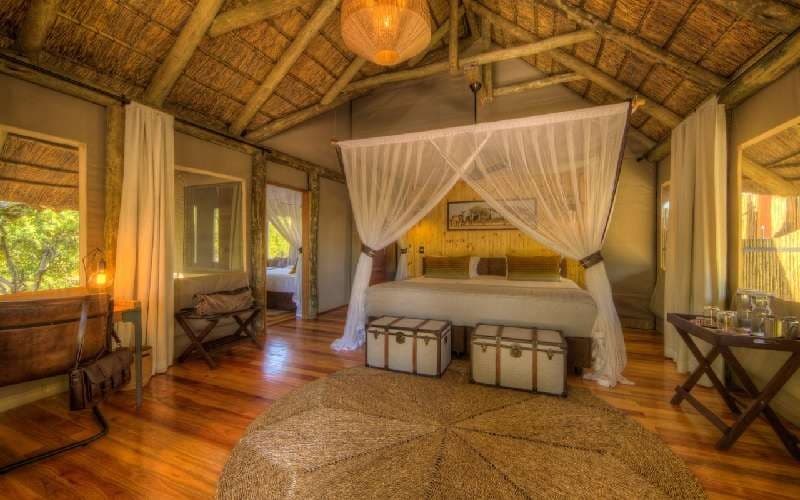
This region pairs well with a stay in the Okavango Delta to contrast water and desert, or with Chobe for a complete west-to-east itinerary. The Tuli Block, further southeast, can round out a circuit for those with 15 days. Comfort ranges from the classic mobile camp (dome tents, solar shower, meals around the fire) to semi-luxury lodges like San Camp or Tau Pan, where bedding and service are high-end despite the isolation. This region suits contemplative travelers, photographers, night-sky enthusiasts, and those who have already experienced classic safari and seek a less-trodden Botswana. Less suited for families with young children, due to long transfers and the low number of visible predators daily.