Complete Guide to Botswana
Botswana holds a distinctive place in southern Africa. Our team based in Gaborone has accompanied travelers for years in search of what few destinations still offer: pristine wilderness, abundant wildlife, and a low-density tourism policy that deliberately limits visitor numbers in protected areas. The country dedicates nearly 40% of its territory to conservation, which you feel firsthand on the ground—few vehicles around the same animal, spaced-out camps, a genuine sense of isolation.
Four regions structure most of our itineraries. The Okavango Delta, that labyrinth of water and papyrus fed by Angolan rains, can be explored by mokoro (traditional dugout canoe) or 4x4 depending on the season. Chobe National Park to the north concentrates Africa's largest elephant populations, around 130,000 individuals. The salt pans of Makgadikgadi offer striking mineral landscapes in the dry season, and the central Kalahari is home to black-maned lions and the San, the desert's indigenous people.
Botswana naturally combines with Victoria Falls on the Zimbabwean side or Namibia for travelers with three weeks available. For a first discovery, plan 10 to 14 days on the ground to visit the Delta and Chobe without rushing. Our role is to calibrate the right balance between bush camps, lodges, and air transfers, knowing that distances are long and tracks sometimes demanding.
The regions of Botswana
Each region has its own personality: climate, landscapes, pace of life and ways of traveling. Our local team helps you choose the combination that suits you.
Okavango Delta
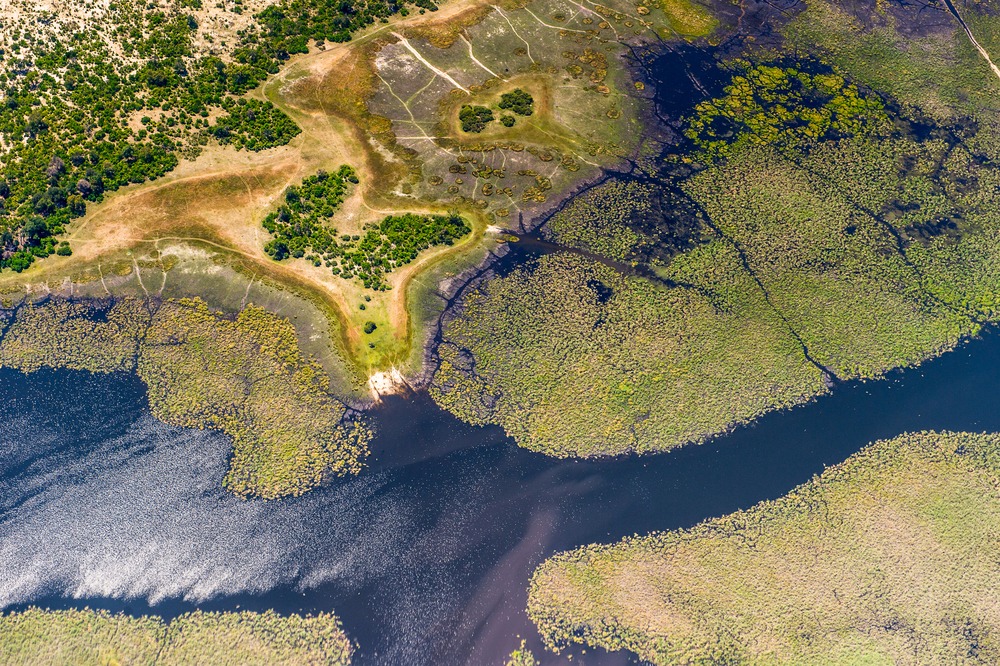
The Okavango inner delta stretches across 15,000 km² in the northwest of the country, fed each year by floods from Angola between May and August. It is in this mosaic of channels, islands and floodplains that our travelers glide in mokoro at daybreak, guided by a boatman from Seronga or Maun. Private concessions such as Khwai or Moremi allow 4x4 safaris off the beaten path, sometimes at night. Temperatures reach 35°C in October, the hottest month, but it is also the period when wildlife concentrates around water points. Plan for a minimum of three nights on-site to grasp the rhythm of the delta.
Chobe National Park
In the north-east, Chobe covers nearly 11,700 km² and borders the river of the same name, a natural frontier with Namibia. The Serondela region attracts elephants in entire herds during the dry season, from July to October, when they come down to drink in the late afternoon. Our guides organize sunset boat safaris from Kasane, the park's gateway 80 km from Victoria Falls. Hippopotamuses, buffalo and crocodiles can be observed from the water under often better conditions than by vehicle. It's also the logical starting point to combine Botswana and Zimbabwe in just a few hours of driving.
Moremi Game Reserve
Moremi protects the eastern part of the delta, approximately 5,000 km² of mopane forests, lagoons and grasslands. Created in 1963 at the initiative of the Batawana, it was the first reserve managed by a community in Africa. The Xakanaxa and Khwai areas concentrate lions, leopards and wild dogs, a species that has become rare elsewhere on the continent. The access track from Maun remains challenging by vehicle, which is why we often prefer 45-minute charter flights. Temperatures drop to 5°C in June and July, so pack warm clothing for morning game drives.
Kalahari and Makgadikgadi
The heart of the country opens onto central Kalahari, a vast 52,000 km² reserve where San communities and black-maned lions of Deception Valley live. Further east, the Makgadikgadi pans form a collection of dried salt lakes, among the largest in the world. During the dry season, you drive across miles of white crust on quad bikes and sleep under the stars in mobile camps. The rainy season, from December to March, transforms these expanses into wetlands where flamingos and migrating zebras come to nest. Another Botswana, mineral and silent.
Linyanti and Savuti
Between Chobe and the Okavango, the Linyanti and Selinda concessions offer a more exclusive safari experience on land leased from the State and closed to mass tourism. The Savuti channel, which ran dry for decades, began flowing again in the 2010s and now attracts large populations of elephants and predators. Packs of wild dogs are regularly observed there between June and September. The camps in this area, accessible only by charter flight from Maun or Kasane, remain intimate, often with a maximum of six to eight tents, to preserve the quality of wildlife viewing.
Tuli Block
In the south-east of the country, along the Limpopo River that marks the border with South Africa and Zimbabwe, the Tuli Block remains largely unknown. This strip of private land combines rocky landscapes, century-old baobabs and wildlife adapted to semi-arid environments: elephants, elands, oryx. Archaeology enthusiasts will find rock engravings and the Mapungubwe site nearby. It's an interesting option for travellers seeking a different safari experience, on foot or horseback, after visiting the delta. Plan for two to three nights from Johannesburg, accessible by road via the Pont Drift border crossing.
Explore by theme
Unique experiences tailored to every traveler.
Culture & Heritage
Temples, musées, sites historiques
Nature & Landscapes
Parcs nationaux, montagnes, forêts
Sea & Beaches
Littoral, îles, sports nautiques
Wildlife & Biodiversity
Observation animale, sanctuaires, réserves
Activities & Adventure
Trek, kayak, escalade, sports outdoor
Gastronomy
Cuisine locale, marchés, cours de cuisine
We use cookies to improve your experience and measure our site's audience. You can choose what you accept. Learn more.