Victoria Falls
Victoria Falls
On the Zimbabwe-Zambia border, Victoria Falls plunges 1,700 metres wide into a gorge over 100 metres deep. From Kasane, they combine naturally with a safari in Chobe.
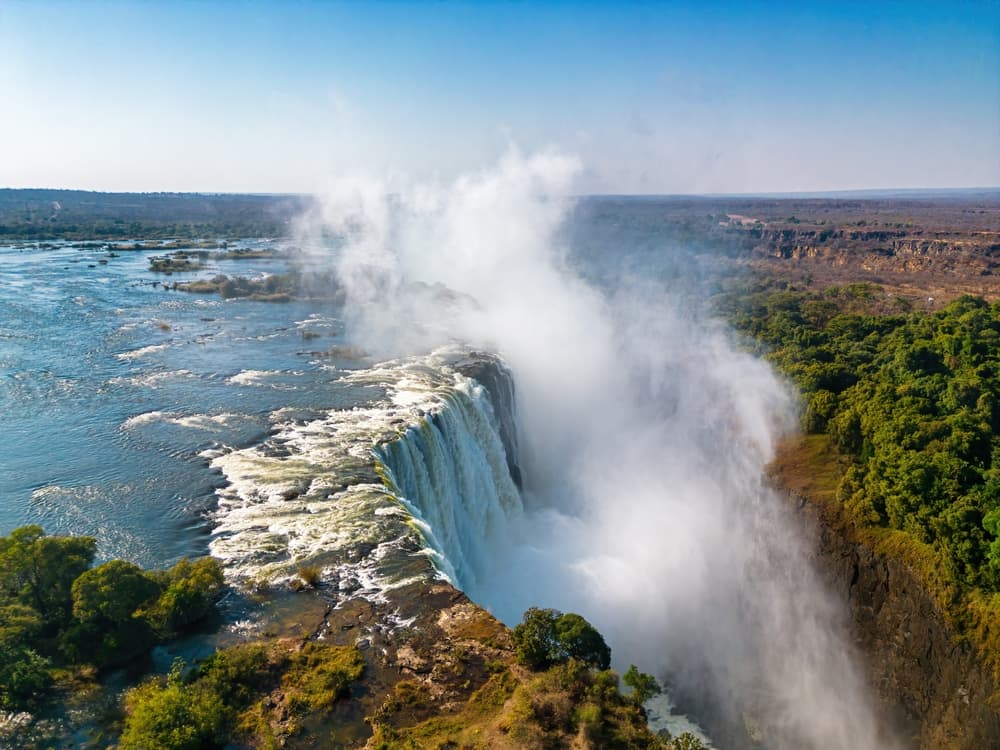
Victoria Falls straddle the border between Zimbabwe and Zambia, yet Botswana offers a natural departure point from Kasane and Chobe National Park, roughly 80 km to the east. Designated a UNESCO World Heritage Site, these falls form one of the world's largest curtains of water: the Zambezi plunges across approximately 1,700 metres into a gorge exceeding 100 metres in depth. The roar and clouds of spray are visible from several kilometres away.
Quick Facts
- Access from Botswana: typically departing from Kasane, via the road towards Kazungula then into Zimbabwe or Zambia.
- Entrance fee: payable on both sides (Zimbabwe and Zambia); rates vary by nationality — check with your local operator beforehand.
- Recommended duration: half a day minimum for the Zimbabwean side; a full day to experience both banks.
- What to wear: waterproof jacket or poncho strongly recommended — spray soaks visitors even in the dry season.
- Best time: March to May for maximum water flow; September to November for optimal visibility in the gorges.
What You'll See
The Zambezi descends in a series of continuous falls spanning the entire width of the river. On the Zimbabwean side, a trail runs along the bank facing the falls, offering frontal views of several distinct cataracts. On the Zambian side, you can approach the upper edge of the precipice. The humid rainforest vegetation fringing the gorges contrasts sharply with the dry savanna beyond.
History and Context
Scottish explorer David Livingstone was the first European to document the falls, in 1855. He named them after Queen Victoria; the local populations call them Mosi-oa-Tunya, "the smoke that thunders". This name appears in the UNESCO designation, which encompasses both the Zimbabwean site and the adjoining Zambian national park.
Highlights of Your Visit
The Falls Trail (Zimbabwean side)
A series of numbered viewpoints allows you to observe different sections of the falls. The "Devil's Cataract", at the western end, is accessible within minutes from the main entrance. On clear days, a permanent rainbow forms in the spray by mid-morning.
Victoria Falls Bridge
Built in 1905, this railway and road bridge spans the gorge between Zimbabwe and Zambia. It offers a dramatic plunge view into the First Gorge and remains an iconic crossing between the two nations.
The Zambian Bank and the "Boiling Pot"
On the Zambian side, a trail descends to the "Boiling Pot", the churning basin at the foot of the falls. In the dry season, certain rocks allow you to approach the upper edge of the Zambezi just before the drop.
"Devil's Pool" (Dry Season)
During low water (typically September to December), a natural pool forms on the very brink of the falls on the Zambian side. Access is via licensed guide from Livingstone Island — an experience reserved for confident swimmers.
Photography Tips
Morning light (before 10 am) is ideal on the Zimbabwean side to avoid backlighting. Protect your camera with a waterproof bag or poncho: spray is intense during high season. In the dry season, gorge visibility improves but water volume decreases. A wide-angle lens captures the breadth of the falls from panoramic viewpoints.
Location and Access
The falls lie on the Zimbabwe-Zambia border. From Kasane (Botswana), the road route passes through Kazungula and crosses via the Kazungula Bridge or Ramokgwebana border post depending on your chosen route. Many travellers combine the falls with a safari at the Chobe National Park. English-speaking agencies in the Nomadays network arrange day trips from Kasane.
Nearby Attractions
- Chobe National Park — one of Africa's highest-density elephant reserves, approximately 80 km from the falls.
- Kasane — a Botswana hub town at the confluence of four countries, the logistical gateway for the region.
- Okavango Delta — another UNESCO site in Botswana, accessible by air from Kasane.
Frequently asked questions
From March to May, the Zambezi is in flood and the falls reach full volume. From September to November, water levels are lower, gorge visibility improves and Devil's Pool becomes accessible. Avoid June to August if you want to see significant water flow.
Yes. The falls straddle Zimbabwe and Zambia: a visa or KAZA pass (Kavango-Zambezi UniVisa) is required depending on your nationality. Consult your operator before departure, as requirements vary.
The Zimbabwean side offers the most comprehensive frontal views of the entire falls. The Zambian side allows closer approach to the upper edge and access to Devil's Pool in the dry season. Ideally, experience both in a single day.
Yes, this is one of the most popular itineraries in the region. Kasane serves as your base for Chobe, and the falls are accessible as a day excursion. Plan at least two nights in Kasane to experience both without rushing.
Yes, photography is permitted throughout the falls trail. Protect your equipment from spray with a waterproof cover, especially during high season when water projections are particularly intense.
Allow half a day to walk the trail on one side. A full day enables you to explore both banks and visit the historic bridge. From Kasane, an organized excursion typically lasts the entire day.
Interested in this visit?
We can include it in your personalised itinerary.